


Door Gifts & Event Giveaways
The Definitive Guide to Eco-Friendly Corporate Gifts in Singapore (2026)

Estimated reading time: 10 minutes
The Definitive Guide to Eco-Friendly Corporate Gifts in Singapore (2026)
Discover the best sustainable corporate gifts for Singapore businesses in 2026.
From recycled materials to bamboo products — expert guidance from The Gift Empire’s sustainability range.
Sustainable corporate gifting is no longer a niche preference — it has become a mainstream expectation. Singapore’s largest organisations, including many of the MNCs we work with at The Gift Empire, now have explicit sustainability commitments that extend to procurement decisions. For their suppliers, partners, and peers, this means that the gifts you choose increasingly reflect not just your brand’s generosity, but its values.
The good news is that the sustainable gift market has matured considerably. The days of choosing between eco principles and product quality are largely behind us. Today’s best sustainable corporate gifts are genuinely excellent products that happen to be made responsibly — a combination that resonates with recipients in ways that generic items never quite manage.
This guide covers everything you need to know to build a sustainable gifting programme: what eco-friendly really means, the best product categories, what to look for when evaluating suppliers, and how to communicate your sustainability commitment effectively.
1. What Makes a Corporate Gift Truly Eco-Friendly?
The term “eco-friendly” is used liberally in marketing, which makes it essential to understand what it actually means — and what it does not.

Materials
• Recycled and upcycled materials — products made from post-consumer recycled plastics, reclaimed wood, recycled paper, or upcycled fabric divert waste from landfill and reduce demand for new raw materials.
• Natural and rapidly renewable materials — bamboo, cork, organic cotton, and jute are popular choices because they grow quickly with minimal inputs, are biodegradable, and have low environmental footprints.
• FSC-certified wood and paper — the Forest Stewardship Council certification ensures wood and paper products come from responsibly managed forests.
• BPA-free and food-safe materials — for drinkware and food-related products, freedom from harmful plasticisers is an important environmental and health consideration.
Production and Supply Chain
Beyond materials, true sustainability also encompasses how a product is made: the energy sources used in manufacturing, fair labour practices, local or regional sourcing that reduces transport emissions, and production facilities with ISO 14001 environmental management certification.
End of Life
Sustainable gifting also considers what happens when a product reaches the end of its useful life. Products that are biodegradable, recyclable, or refillable have a lower total environmental impact than those that go straight to landfill. Packaging, too, matters: plastic wrapping undermines an eco product’s credentials immediately.
Longevity
Perhaps the most overlooked aspect of sustainable gifting is durability. A high-quality product used daily for five years has a far lower environmental footprint than a cheap item discarded within months. As a result, sustainable gifting and premium gifting are more aligned than they might initially appear.
Explore The Gift Empire’s sustainable gift range from bamboo accessories and recycled material bags to eco-packaged hampers — browse our full sustainability collection.→ Browse Our Catalogue
2. Why Eco-Friendly Gifting Is Now a Business Imperative
ESG Mandates Are Changing Procurement
Environmental, Social, and Governance (ESG) commitments have moved from voluntary statements to operational requirements for many of Singapore’s largest organisations. Procurement policies at MNCs increasingly specify sustainability criteria for suppliers and the products they source. For gifting budgets, consequently, this means demonstrating that your chosen gifts align with your organisation’s ESG commitments — and potentially with your clients’ commitments too.
Recipient Expectations Have Shifted
Research shows that younger professionals — now a significant share of Singapore’s corporate workforce — actively prefer sustainable products and respond more positively to organisations that demonstrate environmental responsibility. A sustainable gift communicates values that matter to this group in a way that a conventional promotional item simply cannot.
Brand Differentiation
In a market where most corporate gifting is still dominated by generic promotional items, an eco-friendly gift programme creates a genuine point of difference. It signals that your organisation thinks carefully about the impact of its decisions — a quality that translates beyond gifting into how clients and partners perceive your overall approach to business.
Regulatory Trajectory
Singapore’s Green Plan 2030 signals a clear direction of travel for environmental regulation. Organisations that build sustainable practices now — including in gifting and procurement — are therefore better placed for a regulatory environment that is likely to become progressively more demanding.
3. Best Eco-Friendly Corporate Gift Categories
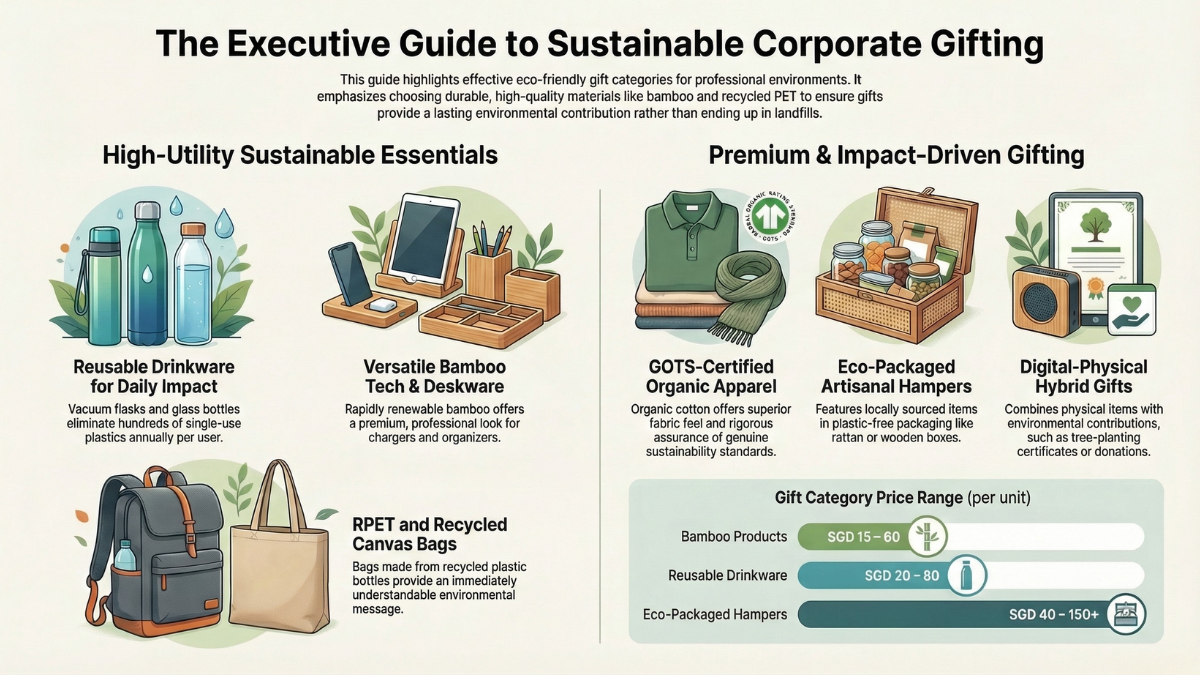
Reusable Drinkware (SGD 20–80 per unit)
Quality reusable drinkware is the sustainable gift with the widest appeal and highest daily-use potential. Stainless steel vacuum flasks, double-wall tumblers, and glass bottles with protective sleeves eliminate single-use plastic across hundreds of interactions per year.
Look for: BPA-free materials, durable construction, broad temperature retention (hot and cold), and comfortable ergonomics. Laser-engraved or powder-coated branding is more durable and visually stronger than adhesive labels. This is, in fact, one of the most popular categories in our sustainability range.
Bamboo Products (SGD 15–60 per unit)
Bamboo has become one of the most versatile and credible sustainable materials in corporate gifting. It grows rapidly without pesticides, is stronger than many hardwoods, and produces a clean, premium look that resonates in professional environments.
Popular bamboo gift options include: bamboo wireless charging pads, bamboo desk organisers, bamboo cutlery sets, bamboo notebooks and writing instruments, and bamboo travel accessories. These items carry a clear sustainability story and deliver a natural, sophisticated look that reads as premium.
Recycled Material Bags and Totes (SGD 20–60 per unit)
Bags made from recycled PET plastic (RPET), recycled canvas, or organic cotton offer large branding areas, strong daily-use potential, and a clear sustainability story. RPET bags in particular — made from recycled plastic bottles — have an immediately understandable environmental message that recipients appreciate.
Choose bags with reinforced stitching and quality hardware. Sustainability credentials mean nothing if the product fails within a month. As a result, quality construction is the most important variable in a bag’s lifespan — and therefore in its actual environmental contribution.
Organic Cotton Apparel (SGD 25–70 per unit)
Branded apparel remains popular for team events, conferences, and onboarding kits. Organic cotton shirts, polos, and tote bags cost a small premium over conventional cotton equivalents, but they deliver both sustainability credentials and superior fabric feel.
GOTS (Global Organic Textile Standard) certification provides the most rigorous assurance that organic cotton has been produced and processed to genuine standards. Ask your supplier for certification documentation.
Eco-Packaged Hampers and Gift Sets (SGD 40–150+)
Hampers assembled from locally sourced, artisanal, or organic products — packaged in recyclable or reusable containers rather than single-use plastic — represent a strong sustainable gifting option for team gifts, CNY, and year-end occasions.
The sustainable hamper market in Singapore has grown substantially in recent years. Options now include organic teas, fair trade coffees, natural skincare products, artisanal honey, and responsibly sourced snacks. Packaging in wooden boxes, rattan baskets, or kraft paper creates an aesthetic that is both premium and environmentally consistent.
Digital-Physical Hybrid Gifts
An emerging category: gifts that combine a quality physical item with a digital element — a personalised digital note, a plant-a-tree certificate, or a donation to an environmental cause in the recipient’s name. These hybrid gifts appeal particularly to organisations with
strong public sustainability commitments and to recipients who are vocal about environmental values.
4. Communicating Your Sustainability Commitment
A sustainable gift programme is only as effective as the story you tell around it. Recipients who do not understand why a gift is sustainable, for instance, miss the key message entirely.
• Include a brief product card or note explaining the gift’s sustainability credentials — what it is made from, what it replaces, or what environmental standard it meets. Keep this brief and factual; avoid greenwashing language that overstates impact.
• Reference your organisation’s broader sustainability commitments if relevant. Framing the gift within your ESG programme gives it additional meaning and signals that it is part of a deliberate strategy, not a one-off gesture.
• Choose packaging that is consistent with the message. A sustainable product wrapped in layers of single-use plastic, consequently, undermines everything the product itself communicates.
• Be specific about certifications and standards. “Eco-friendly” is easy to claim; GOTS-certified organic cotton, FSC-certified paper, or verified RPET content are harder to fake and more meaningful to informed recipients.
5. Evaluating Suppliers for Sustainability Credentials
Not all suppliers who offer “green” products apply the same standards. When evaluating a corporate gift supplier for sustainable options, ask:
• Can you provide certification documentation for claimed environmental standards (GOTS, FSC, RPET)?
• What packaging materials do you use for orders, and are these recyclable or biodegradable?
• Where are your sustainable products manufactured, and do you have information on the production facilities’ environmental practices?
• Can you recommend products that are locally or regionally sourced to reduce transport-related emissions?
• Do you offer sample ordering so we can verify quality before committing to bulk quantities?
At The Gift Empire, our team can provide full product specifications and certification details for our sustainability range, helping you make procurement decisions that will stand up to scrutiny from your own compliance and ESG teams.
Get personalised recommendations for your sustainability programmeOur account managers can help you select products that meet both your gifting goals and your ESG commitments >
6. Budget Guidance for Sustainable Gifting
A common misconception is that sustainable corporate gifts are significantly more expensive than conventional alternatives. While some premium eco products do carry a price premium, the gap has narrowed considerably as the category has matured.
• Entry-level sustainable gifts (SGD 15–30): Bamboo writing instruments, RPET totes, reusable cutlery sets, organic cotton pouches.
• Mid-range sustainable gifts (SGD 30–70): Quality bamboo desk accessories, stainless steel drinkware, organic apparel, eco hampers.
• Premium sustainable gifts (SGD 70–150+): Premium vacuum flasks, leather-free executive accessories, large eco hampers, curated sustainable gift sets.
For most corporate gifting programmes, the mid-range tier offers the best balance of product quality, sustainability credentials, and budget efficiency. The premium tier is appropriate for VIP clients and senior executive gifting, where the investment is justified by relationship value.
Frequently Asked Questions
Are sustainable gifts more expensive than conventional corporate gifts?
Not necessarily. The premium for sustainable materials has reduced as the market has matured. Quality bamboo and RPET products are now comparably priced to conventional equivalents at the same quality level. In some cases — particularly for drinkware, where stainless steel outperforms plastic on both sustainability and durability — the eco option is also the better-value option over its lifespan.
How do I avoid greenwashing in my gifting programme?
Focus on specific, verifiable claims rather than general “eco-friendly” language. Request certification documentation from your supplier. Communicate clearly about what makes each product sustainable — materials, production method, or end-of-life — and avoid overstating impact. Being honest and specific is both ethically correct and more credible to informed recipients.
Can sustainable gifts be fully customised with our brand logo?
Yes. All of The Gift Empire’s sustainable gift options are available with standard branding options including laser engraving, screen printing, and embroidery depending on the product type. We recommend laser engraving for bamboo and metal products, embroidery for organic cotton apparel, and screen printing for RPET bags.
What is the most popular sustainable corporate gift in Singapore right now?
Based on our order data, premium reusable drinkware — particularly vacuum-insulated stainless steel tumblers and flasks — remains the most popular sustainable corporate gift in Singapore. Bamboo desk accessories and RPET tote bags are also consistently popular across sectors.
The Gift Empire has been Singapore’s trusted corporate gift supplier since 1999, offering an extensive range of sustainable and eco-friendly gifting options alongside our full 3,000+ product catalogue. Our account managers can help you build a sustainable gifting programme that meets your ESG commitments without compromising on quality or brand impact.
Sourcing and supply since 1999
At The Gift Empire, we have spent 26 years helping Singapore’s most respected organisations — from Fortune 500 firms like Amazon, Microsoft, and Citibank to ambitious homegrown SMEs — navigate corporate gifting with precision and purpose.
-
Door Gifts for Corporate Events in Singapore #2
Door Gifts for Corporate Events in Singapore: What to Give and Why It Matters
-
Door Gifts for Corporate Events in Singapore
Door Gifts for Corporate Events in Singapore: What to Give and Why It Matters
-
Why Canvas Bags Are Great for Eco-Friendly Marketing
Why Canvas Bags Are Great for Eco-Friendly Marketing “A canvas bag doesn’t just carry things — it carries your brand into every MRT carriage, coffee queue, and meeting room your recipient visits.” In Singapore’s increasingly sustainability-conscious corporate landscape, the canvas bag has earned its place as one of the most versatile and effective promotional items available. It…
-
The Definitive Guide to Eco-Friendly Corporate Gifts in Singapore (2026)
At The Gift Empire, our team can provide full product specifications and certification details for our sustainability range, helping you make procurement decisions that will stand up to scrutiny from your own compliance and ESG teams. Frequently Asked Questions
-
Employee Milestone Gift Ideas
Corporate Gift Guide Employee Milestone Gift Ideas: A Strategic Guide for Singapore Companies (2026 Edition) Employee milestones are more than HR formalities. In Singapore’s competitive corporate landscape, they are strategic moments that shape company culture, employer branding, and long-term retention. Whether you are recognising a 5-year work anniversary, celebrating a promotion, honouring retirement, or rewarding…
-
The Ultimate Guide to Corporate Gifting for Singapore Businesses (2026)
Category: Corporate Gifting Insights | Updated: February 2026 Corporate gifting is one of the most underutilised tools in a business’s relationship-management arsenal. Done well, a thoughtfully chosen gift communicates respect, strengthens loyalty, and keeps your brand front of mind long after a meeting ends. Done poorly, it signals indifference — or worse, poor judgement. At…


